Introduction
Artificial intelligence (AI) became an enormously popular term in 2017 and 2018. The best-known example is AlphaGo: in March 2016, the Go-playing AI developed by Google DeepMind defeated South Korea's top professional player Lee Sedol, becoming the first computer Go program to beat a professional 9-dan player without a handicap and setting a milestone for artificial intelligence. Why is AI taking off now? What breakthroughs made it so capable? Will it truly affect human jobs in the future? We explain each of these questions in the sections below.
A Brief History of Artificial Intelligence
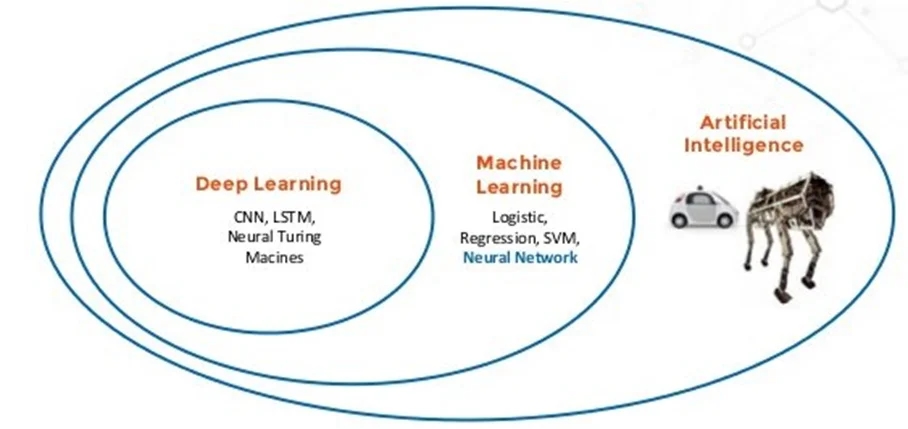
You have probably heard several terms over the past few years: artificial intelligence (AI), machine learning and deep learning. How exactly are they related? By strict academic definition, deep learning is a subset of machine learning, and machine learning is a subset of artificial intelligence. The core problems of AI include building capabilities that resemble or even surpass those of humans in reasoning, knowledge, planning, learning, communication, perception, movement and the manipulation of objects (Wikipedia), while machine learning and deep learning belong to the areas of reasoning, knowledge, planning and learning.
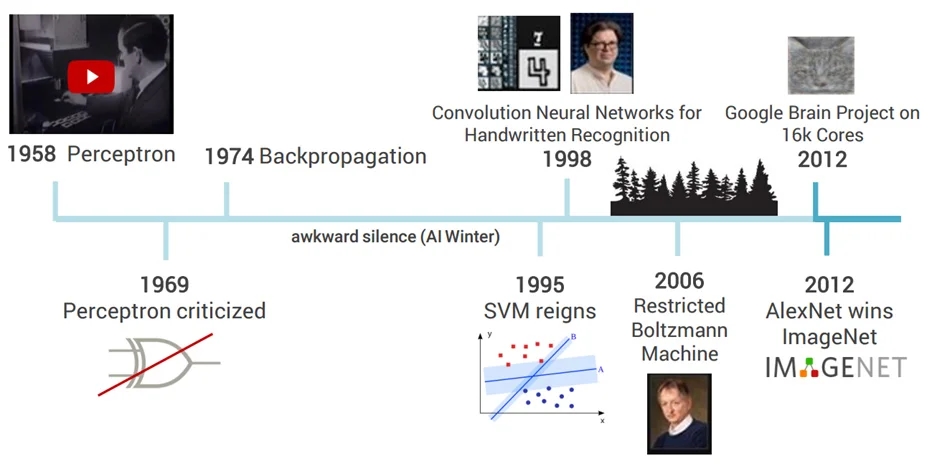
The term artificial intelligence is nothing new; it first appeared 20 to 30 years ago, and its history has seen three waves of enthusiasm and two winters. The two winters had two causes: there was no clear theoretical definition, and hardware lacked the computing power to verify whether the ideas worked. Since 2010, however, the graphics processing units (GPUs) developed by NVIDIA have delivered massive computing power, and combined with big data and deep learning algorithms, they have broken through the limits of the past in one stroke.
Weak AI and Strong AI
Artificial intelligence can be divided into three levels. First, weak AI: it learns and reasons about a single task, and does it very well, but it cannot extend its understanding beyond that task on its own. Second, strong AI: intelligence equivalent to a human's, with self-directed learning across multiple tasks and the expression of emotion. Third, superintelligence: it has all the capabilities of strong AI, and every one of those capabilities far exceeds that of humans.
To date we are still at the stage of weak AI. AlphaGo is very strong at Go, but Go is all it can do; it does not develop other skills. Interestingly, many scholars and entrepreneurs have begun to hold differing views on the development of AI. One camp argues that we need to guard against AI spiraling out of control and threatening humanity; the other holds that there is no need to worry too much at the current stage of development, since the human ability to process information still far exceeds that of today's computers.
The Future of Artificial Intelligence
Today, thanks to big data, deep learning and greater GPU computing power, AI has made great strides forward. The world's major companies are pouring resources into research and development, and Taiwanese companies are no exception. Beyond the big players, AI has also given many startup teams a wide range of topics to work on. In the future, what AI sells is a service to people: assisting humans in completing specific tasks.
Worth watching in 2018 are new types or new applications of AI algorithms, as well as AI on a chip (the AI Chip). When Apple launched the iPhone X, it announced that it had built a neural-network hardware architecture into the processor, and dozens of companies around the world will release AI chips this year. Once AI chips are everywhere, AI will surround every aspect of daily life. What will life look like then? We will wait and see!