With accelerating urbanization and the push for smart city policies, "traffic monitoring" has become one of the issues government departments and related businesses care about most.
Traditional traffic counting relies mostly on manual observation or installed sensors, which are costly, hard to maintain and slow to adapt to changes in the environment.
Now, with the WinEdge-TC solution, we can track vehicle flows in real time using computer vision and rapidly deploy a high-precision traffic tracking and counting system, opening a new chapter in smart city governance and site management.
⭐ Application goal: traffic counting and directional flow analysis ⭐
AIWin's solution focuses on the following core goals:
• Real-time recognition and classification of vehicle types (such as cars, motorcycles, buses and trucks)
• Custom definition of multiple monitoring zones and directions (for example, A → B, B → C)
• Precise tracking of movement paths and crossing times
• Traffic volume statistics by vehicle type and direction for each time interval
• Support for edge-device inference and WebSocket streaming
⭐ Real-world scenario
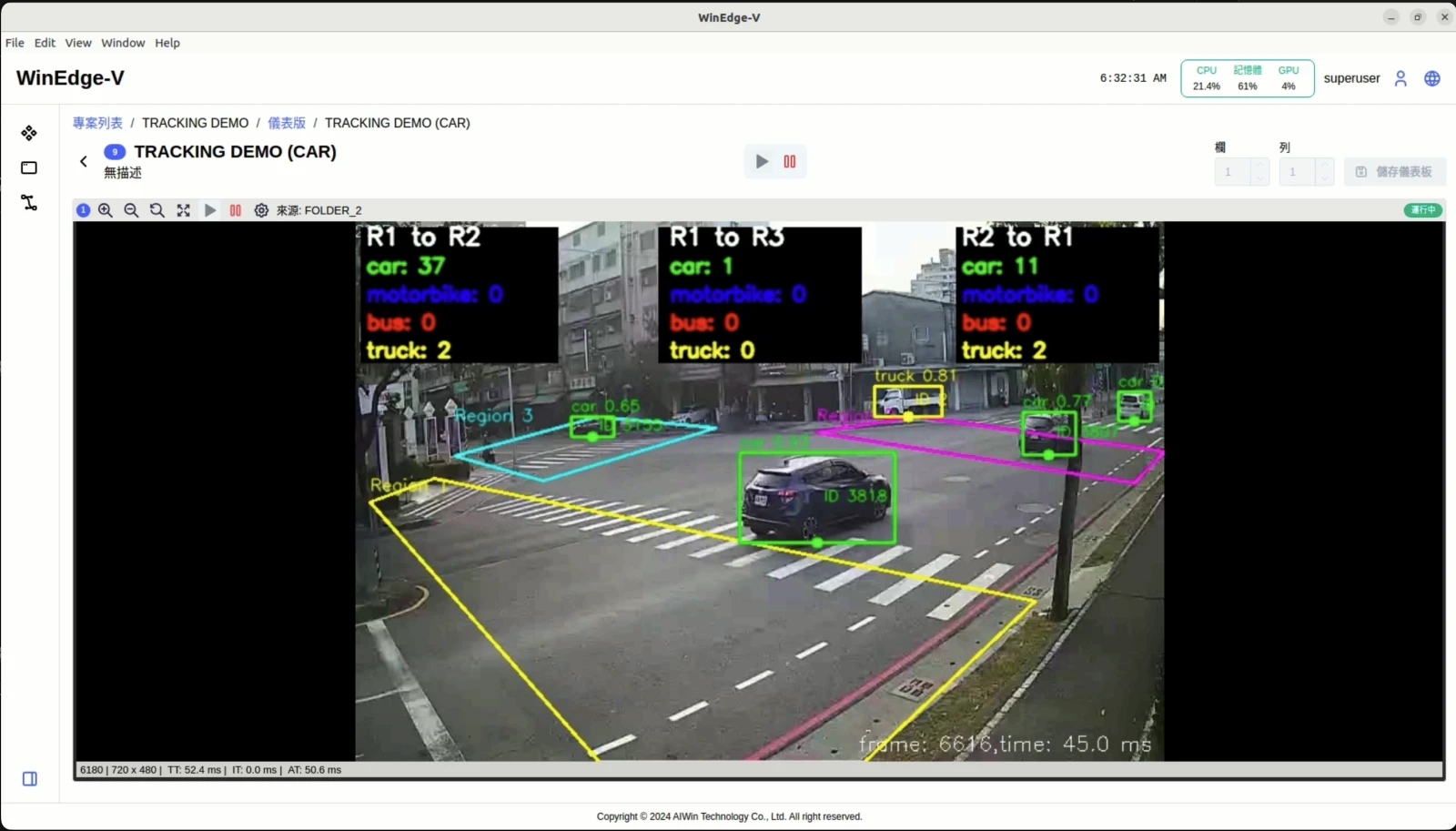
T-junction traffic flow analysis: carried out at a T-junction in central-southern Taiwan, using a fixed camera covering 3 main directions.
The camera defines three polygonal ROIs (for example, region1, region2 and region3).
An AI model recognizes the various vehicles, and a tracker records flows by direction, such as region1 → region2.
Statistical reports and vehicle-type distribution charts are generated automatically every hour.
⭐ Results and advantages
After adopting WinEdge-TC, the efficiency and quality of traffic monitoring improved significantly:
• Saves labor: counting traffic by hand used to take a large amount of manpower every day; now the system runs fully
automatically, delivering a counting process with zero manual input and zero delay.
• Real-time vehicle classification: judging vehicle types by eye was time-consuming and error-prone. Now the system recognizes
multiple vehicle types in real time, making the statistics more accurate.
• Lower equipment maintenance costs: compared with failure-prone in-ground sensors, cameras paired with AI software modules reduce
repair frequency and total maintenance costs.
• Better real-time response and visualization: data used to be compiled and analyzed after the fact; now video and
tracking data are streamed back in real time, making real-time monitoring and decision-making easy.
• More flexible use of data: the structured data the system produces can be fed directly into traffic control centers, smart signals or other
IoT systems, enabling real-time control and trend analysis.
Video: https://www.facebook.com/aiwin.tech/videos/1051248899914168/