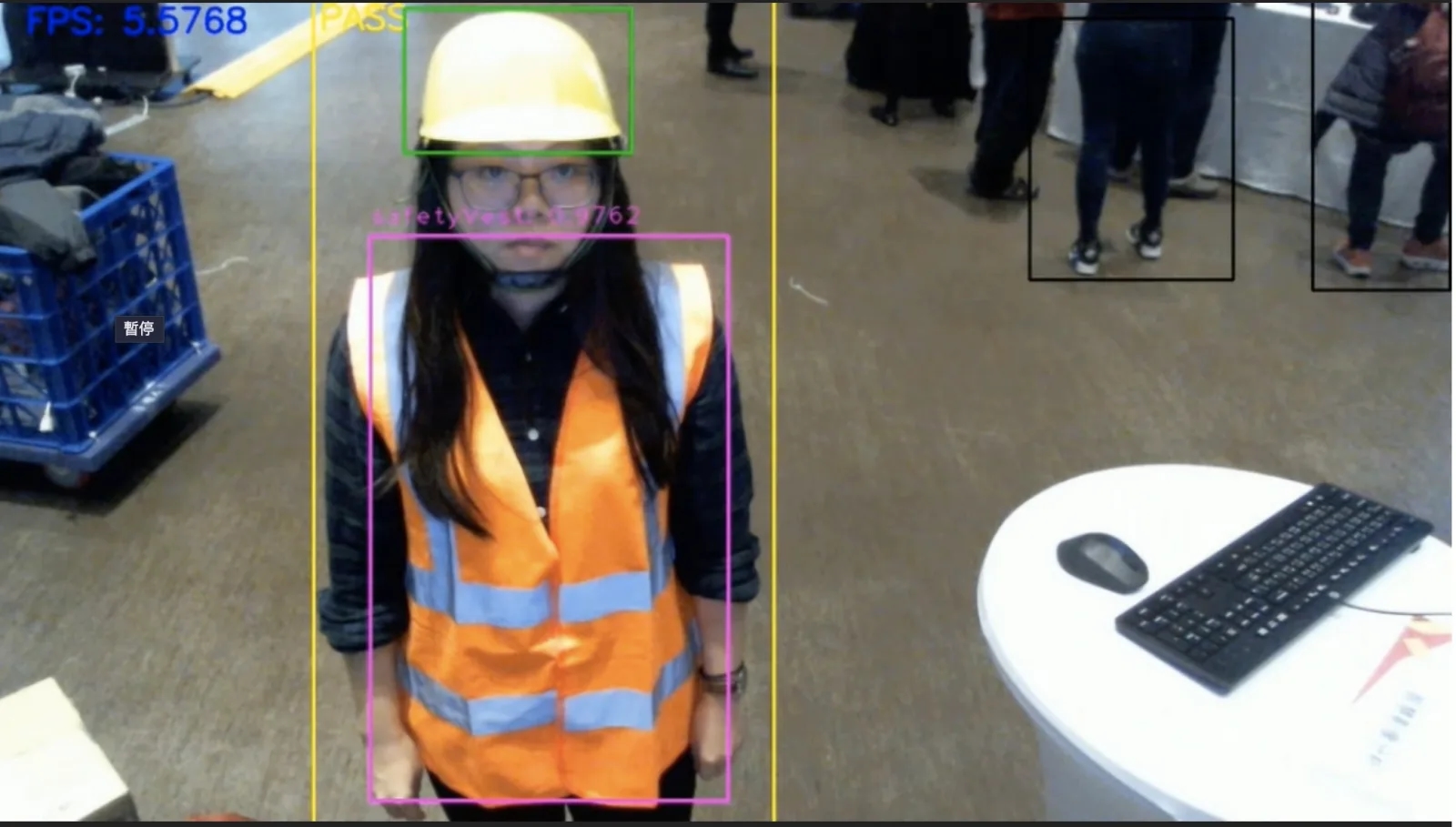
AIWin chose to bring AI image recognition into the factory. From the textile industry to golf ball companies, it has cleared one hurdle after another, and it now has more than ten deployed projects and has run proofs of concept with more than thirty companies across more than ten fields.
When companies use AIoT for digital transformation, what many of them want is to use image recognition for defect inspection and factory safety. AIWin, a member of the Chinese Asia Pacific AIoT Development Association, is a vendor with exactly this kind of AI capability.
AIWin provides AI image recognition solutions for smart factories and helps customers build an AI "virtuous cycle": an end-to-end service covering data cleaning, labeling and organization, AI training and modeling, and hardware-and-software integration. It continuously applies the latest image recognition algorithms, puts them into real-world, practical use, and optimizes the corresponding machine learning and neural network models to balance speed and accuracy. The companies and industries it has entered so far include defect inspection for golf ball companies, textile manufacturing, petrochemicals and steel, as well as factory safety management in the semiconductor industry.
When it was founded in 2016, AIWin explored AI applications across many fields and also carried out the government SBIR project "Deep learning applied to a forward image recognition system for advanced driver assistance systems." Weighing demand and immediate benefits, AIWin chose to bring AI image recognition into factories. From the textile industry to golf ball companies, it has cleared one hurdle after another, and it now has more than ten deployed projects and has run proofs of concept with more than thirty companies across more than ten fields, giving it a wealth of experience. What these deployed projects have in common is that cameras provide fast, real-time images, and AI image recognition is then performed in real time.
To date, AIWin holds three Taiwanese patents: an intelligent multifunctional driving-assistance recording method and system (I619099), an ultra-wide-depth stereoscopic imaging system and method (I619372), and an intelligent image information and big-data analysis system and method using deep learning (I647626). This year it has also expanded its patent portfolio for AI applied to specialized fields, filing 2 invention patents in Taiwan, with filings planned in the United States and other countries next year, which shows its considerable strength in this area.
Take a golf ball factory as an example. In AIWin's solution, the inspection process sends the ball to be inspected into an inspection machine, photographs it through a 360-degree rotation, uses AI image recognition to identify defects, and finally sorts the ball. But a single golf ball can have 28 different types of defect; the defect categories have to be defined and their size ranges judged. So through early collaboration with the partner manufacturer, the relevant data and image data were collected and labeled using niche domain know-how before a model could be built.
After 1–2 years of deep data work and live operation, the system can now inspect 100,000 balls a day, with manpower reduced by 30–50% and quality improved more than 10-fold. Its miss rate (defective balls not detected) is 0.02–0.04%, and its overkill rate (good balls judged defective) is 5–15%.
AIWin has further improved its algorithm development this year, developing in particular the ability to recognize defects in textile products from small samples, which is especially beneficial for the highly varied textile industry. A hidden-champion shoe-webbing manufacturer in central Taiwan has adopted AIWin's solution, achieving manpower optimization of 10–50%, quality improvement of 10–15%, a miss rate of 1–2% and an overkill rate of 2–3%.
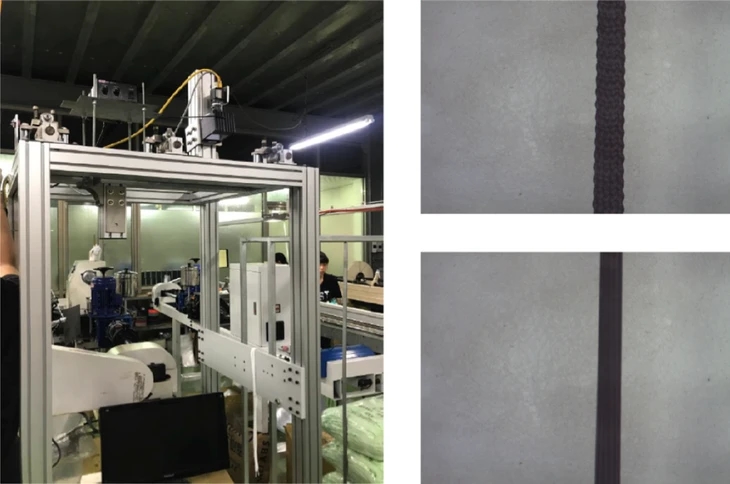
AIWin's shoe-webbing inspection. Source: AIWin
In addition, a major memory-chip maker in central Taiwan has applied AIWin's solution, with system integration by SYSTEX, to jointly develop safety monitoring for a semiconductor wastewater plant. Recognition accuracy reaches 97–99%, and it effectively monitors operators' actions and issues reminders, significantly improving safety supervision.
These results come from understanding customers' pain points. For a company adopting AI image inspection in its factory, the problems before adoption are a shortage of AI talent, insufficient AI infrastructure, excessive AI investment, insufficient data, poorly defined problems and no way to validate the AI; after adoption, the company faces the question of whether it is able to operate and maintain it. So AIWin provides a complete solution as shown in the figure below, and building on its years of experience in real-world AI deployment, AIWin will launch a platform-based service in 2021, committed to letting customers own and operate AI on their own, simply and quickly.
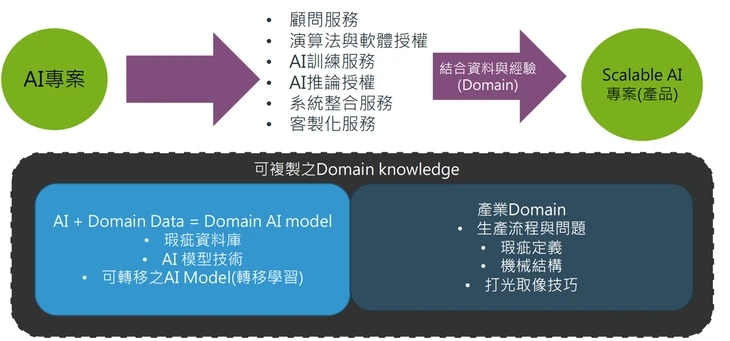
AIWin's complete AI image recognition service. Source: AIWin
AIWin is also a member of the second cohort (AGP2) of the AI startup accelerator launched by SYSTEX Group, the A+ Generator Program (AGP), and a business development partner of SYSTEX. Through this relationship, it received a strategic business investment from SYSTEX last year.
Editor: Chris
Reviewing editor: Lee Po-Feng (李柏鋒)