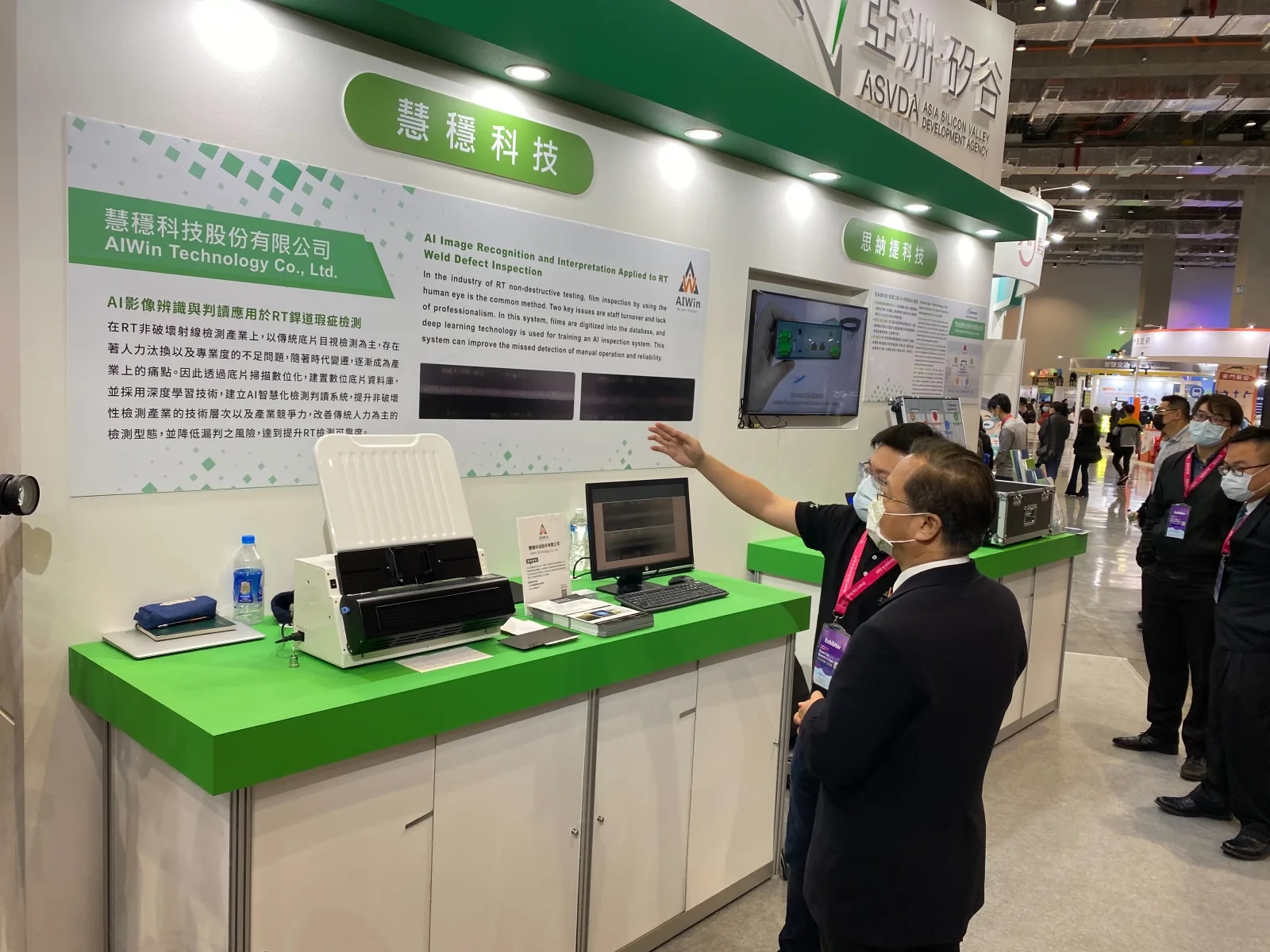
From AI projects to AI products, AIWin's journey took five years!
Drawing on its experience helping more than 30 companies across more than 10 fields adopt AI, in projects large and small, AIWin has built the Domain AI SaaS platform to help companies adopt AI technology quickly, with an estimated time saving of more than 50%.
Founded in 2016, AIWin is a provider of AI image recognition solutions for smart factories. The Domain AI SaaS platform helps customers complete data cleaning, labeling and organization, AI training and modeling, and hardware-and-software integration, putting the latest AI algorithms to practical use.
Five Years in the Making: AIWin Turns Project Experience into AI Products
AIWin CEO Aaron Lin says the company has extensive experience in real-world AI deployment, with successful deployments in golf balls, textiles, petrochemicals, semiconductors and water resources, and has accumulated a large number of application cases.
▲ AIWin has drawn on its extensive AI project experience to launch the Domain AI SaaS platform. Shown: the platform's system architecture.
He analyzes three major pain points industries face in deploying AI successfully:
Pain point 1: talent shortage. From traditional industries to high-tech semiconductors, it is very hard to find people who are both dedicated AI specialists and well versed in domain knowledge. For traditional industries and SMEs in particular, even IT talent is hard to find, let alone AI talent. Rather than spending time hunting for AI talent, it is better to use an existing AI platform that requires no programming (No-Code), so that existing domain experts can use and operate AI. Only this can truly solve today's shortage of technology talent.
Pain point 2: deployment results are hard to evaluate. Statistics show that the success rate of AI deployment is low; even overseas, only 5% of AI deployments create value. The success rate of AI deployments validated through AIWin's projects is also only about 5–10%.
Aaron Lin explains that the difficulty lies in the steps of AI adoption: you must first define the problem, understand the domain knowledge, apply an AI model, and then combine it with a systematic integration solution before industrial business value can be produced. This chain of steps is a cross-disciplinary integration, and validating the results of AI deployment is very difficult; it takes time and manpower, layered on top of each other, to produce results.
Pain point 3: cost. The talent, the time and the work of combining domain knowledge with AI all take time, and once time is spent, investment can become aimless, with the hidden costs of adoption forced ever higher. Add AI hardware on top, and as the related expenses pile up, the result is an awkward situation in which cost and benefit cannot be evaluated.
To solve the pain points of AI adoption in industry, AIWin takes its experience helping companies use AI to solve problems in processes and on production lines, develops validated AI models, and builds a standardized AI SaaS to solve the common problems within a domain. Individual company problems or customization needs are then handled through light customization and tuning on top of that standardized base. At this stage, AIWin's products are divided into two services, an optical inspection AI SaaS platform and a smart water management AI SaaS platform, both of which are No-Code platforms that are simple to use and easy to monitor and operate, letting companies adopt AI at low cost and with high efficiency.
▲ Companies adopting Domain AI SaaS see concrete results such as lower costs and higher efficiency.
Aaron Lin says that according to the benefits AIWin has validated, using the Domain AI SaaS platform in optical inspection can deliver quality improvements of 10% to 10-fold and cut labor costs by 10–50%; in smart water management, energy optimization gains of 10–20% can be achieved.
Textile Industry Adopts AI Platform: 10% Higher Defect Detection, Half the Manpower
For example, when the textile industry relied on full manual inspection for defects, the detection rate was typically between 80% and 90%. After adopting AI optical inspection technology, the detection rate can rise to more than 95%. With manual re-inspection or sampling afterward, this not only raises the defect detection rate by a substantial 10% but also saves nearly half the manpower, a very considerable benefit.
Another example: in the past, when wastewater treatment plants controlled treatment, they first looked at the results of water quality sampling, and then veteran operators or professional technicians adjusted equipment dynamically by hand. There was no way to monitor continuously, which often wasted energy. With AI added, the AI model infers from the monitoring results how much motor or equipment output is needed to keep water quality within a set range, with an estimated saving of more than 20% in energy loss. Municipal wastewater plants and water utilities alike need a smart water management platform to help monitor wastewater treatment.
"Whether it is machine learning, deep learning, dynamically adjusted neural networks, dynamic control algorithms or any other AI technology, adoption requires the right subjective and objective conditions. If the process is unwilling to change and relies entirely on AI, it will still end in failure," Aaron Lin says frankly. AI is not all-powerful, and it can also become a "truth-revealing mirror" that exposes, one by one, the things that manual work used to overlook. That is why the process of communicating with the customer and adjusting, to clearly define which problems to improve and how to verify the benefits, becomes so important.
Firmly Rooted in Taiwan, Eyeing Southeast Asia, Targeting an IPO within 5 Years
Aaron Lin also points out that AI technology must keep improving. The current goal is to get AI to learn well without needing too much data. At the same time, don't over-rely on AI. AI is a double-edged sword, he says: over-reliance means depending on massive data, and collecting and cleaning large volumes of data takes a great deal of time. Combining traditional algorithms with AI technology is the best approach today. Until AI technology matures, traditional algorithms and existing AI technology are used to solve customers' problems first; once there are breakthroughs in strong-AI-like fields such as AI self-learning, causal reasoning and meta-data learning, they will help deliver solutions with even greater business value.
Beyond continuing to promote applications in domestic industries, AIWin also plans to bring the Domain AI SaaS platform to Southeast Asia and other countries in 2022. AIWin is currently actively pursuing a Series A round and, building on its existing success, will continue to expand the depth and breadth of Domain AI SaaS. In the medium term it will also raise an A+ or Series B round, with the goal of an initial public offering (IPO) in about 5 years.
▲ The AIWin team.
▲ AIWin founder and CEO Aaron Lin.
Source: https://aihub.org.tw/ai_case/ef6fbbe259b4012145c58d34341b6f31