Using AI automated optical inspection (AI-AOI) and the artificial intelligence of things (AIoT) to train deep learning models, achieve AI prediction and push factories toward automation, AIWin, known as the "expert in intelligent image analysis technology," has become a third eye for businesses through image recognition.
In recent years artificial intelligence (AI) has taken off and can be applied across every trade and industry, spanning finance, retail, transportation, manufacturing and automation. It is also a key core of the development of 5G, the IoT and industry, and advanced countries are all racing to pour resources into developing AI technology.
Founded in 2016, AIWin focuses on image recognition solutions for smart factories, with particular emphasis on AOI (Automated Optical Inspection). The team has opto-mechatronic integration capabilities and excels at image recognition applications such as product quality inspection, attendance and face recognition, and it builds a complete AI virtuous cycle with its customers.
AIWin becomes a company's "third eye" through image recognition. In concrete terms, step one starts with data assessment and consulting; step two is data organization and labeling; and step three is AI algorithm selection and validation together with AI training services. Through this three-step adoption process, AIWin provides companies with a complete hardware-and-software integration solution, puts the latest AI technology to practical use and genuinely solves their problems.
▲ AIWin's service model
Adopting AOI Inspection via API Integration Dramatically Reduces Defect Rates
AIWin uses a high-precision AOI optical inspection system fitted with industrial cameras and applies deep learning to automatically classify all kinds of fabric defects, dramatically reducing the defect rate. AI is adopted by delivering the AOI inspection service through an API, and the overall quality control standard reaches LFW 99.8%.
AIWin currently focuses on fabric defect inspection, because textile quality inspection in the past could only be done by eye, and the long-term workload on inspectors can lower yield. If AI recognition replaces visual inspection and is woven into production-line quality control and the service environment, high-performance defect inspection can be sustained. Because the work is no longer manual, there is no fatigue, which not only raises the recognition rate but also shortens inspection time, delivering stable and stronger product quality control. In addition, the inspection process can reveal whether other factors are affecting quality, which can be used to improve and standardize production.
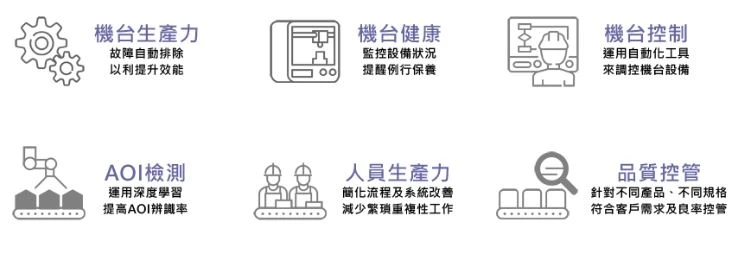
▲ AIWin offers a range of services on the road to Industry 4.0
During adoption, however, some customers have very high expectations of AI, believing that simply adopting AI will replace existing manpower and solve every problem on the production line. In reality, the value of AI comes from accumulating large volumes of high-quality data, then transforming and analyzing it to build AI training and validation models, and only after machine learning and deep learning can it fully solve the problems created by manual work and optimize operating procedures.
For this reason, the AI image recognition technology and deep learning algorithms that AIWin develops and trains have brought intelligent image analysis into the manufacturing chain. Beyond the fabric defect inspection already in use, they can be applied to workplace safety incident recognition, defect inspection systems, human recognition and a range of other customized recognition services, serving a wide variety of application environments.